
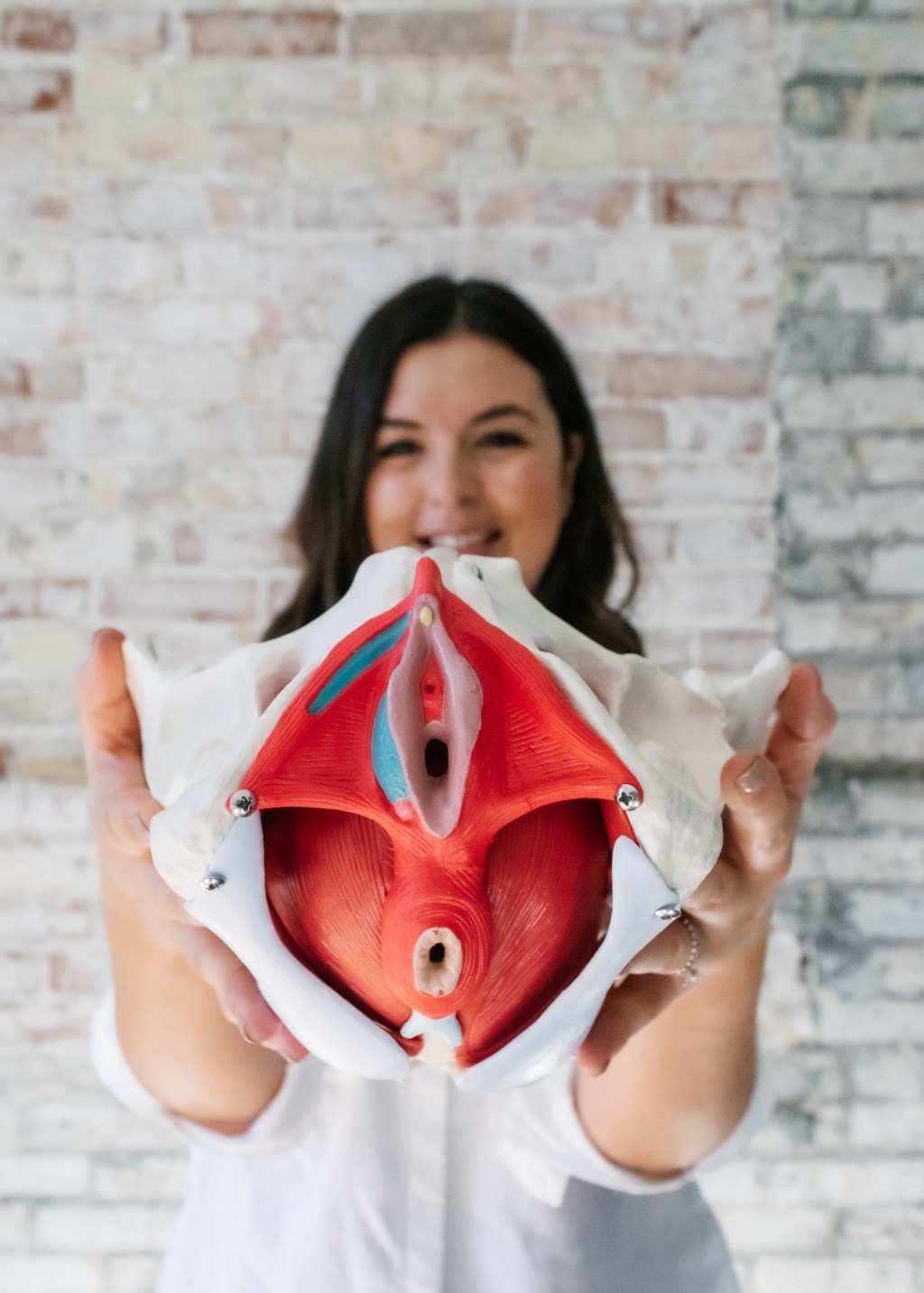
Pelvic health is the foundation of most chronic pelvic pain conditions, including endometriosis, adenomyosis and PCOS. While symptoms of these conditions can be complex to manage, improving your pelvic health can be a great place to start. So, I’m breaking down five simple ways you can start to improve your pelvic health today!
- Learn how to breathe diaphragmatically
The diaphragm is your breathing muscle that sits like a dome in your rib cage. When you inhale this muscle lengthens out to allow your lungs to fill with air. When you exhale, your diaphragm contracts to push the air up and out of your lungs. This is a really important muscle because it always moves in unison with your pelvic floor. When you inhale and your diaphragm lengthens out, your pelvic floor will relax into the bowl of your pelvic. When you exhale and your diaphragm contracts, your pelvic floor will lift, typically thought of as a kegel.
The problem is that many of us breathe with our upper chest instead of breathing deep into the diaphragm. This can unfortunately increase air pressure in the abdomen, which can actually result in tension building up in the pelvic floor muscles. When the pelvic floor muscles are tense, they can create symptoms like; leaking urine, pelvic pain, constipation, painful sex, period pain and much more.
So, one really easy way to improve your pelvic health is to start working on taking deep breaths by using your diaphragm. For more information on the pelvic floor and diaphragm connection, check out the previous guest blog post by Jessica Ryan here!
- Learn how to relax and contract your pelvic floor muscles
As I mentioned above, your pelvic floor muscles move up and down with your diaphragm as you breathe. When we’re talking about this muscle group, what is really important to know is that the pelvic floor muscles have to be able to contract (a kegel) and they have to be able to relax. If the pelvic floor muscles are weak, or they hold too much tension, it can create some of the symptoms I mentioned above. Oftentimes with chronic pain conditions, we struggle to be able to relax the pelvic floor muscles, which can lead to worsening symptoms of pain. If you want more information on pelvic floor tension, check out my blog post here!
Learning how to engage with your pelvic floor is a skill that takes time, but I’m going to give you two simple tips to get started: learn how to breathe with your diaphragm (see tip number 1) and use visual cues to visualize the muscles moving. Our brain’s have a really powerful connection to our pelvic floor, and often you can start to teach your brain how to move this muscle just by practicing visualizations.
My favorite visual cue is a jellyfish. If you imagine how a jellyfish moves in the water, it relaxes its little tentacles and then it squeezes everything together to propel itself forward. So imagine your pelvic floor is like a jellyfish; when you inhale, imagine the jellyfish relaxing and opening up and when you exhale, imagine the jellyfish contracting its tentacles and moving forward.
Practice this with your diaphragmatic breathing, and remember it’s ok if you don’t feel anything. As your brain learns how to get more comfortable with connecting to that muscle, you’ll start to feel the difference between your pelvic floor muscles contracting and relaxing.
- Stop going pee just in case
Having good pelvic health isn’t just about what is happening at the level of the pelvic floor muscles. It’s also about what’s happening with our bowel and bladder function. One of the main functions of our pelvic floor is sphincter control of the bowel and bladder, so you can imagine that what’s happening with our bladder and bowel health will impact the pelvic floor, and vice versa.
One of the easiest ways to start improving things like bladder leaking, bladder urgency and frequency, is to stop going pee just in case. I know, I know, easy to write, hard to actually do, but hear me out!
Your bladder has a muscle around it called your detrusor muscle. When we go pee ‘just in case’, we actually teach that muscle that it has a lower capacity to hold urine then it does. And overtime this can lead to an increase in bladder symptoms like urgency, frequency, and leaking urine.
If you’re not sure how to judge whether or not you should go pee, try these two rules of thumb; you should be going pee about every 2-3 hours. So if you get an urge to pee after only 30-60 minutes, your bladder probably isn’t full, and you should be able to ignore this urge. A length of pee should be 8-10 seconds (or longer). If you go pee and it doesn’t seem like you had a very long stream, your bladder probably wasn’t full. You can start tracking these habits to learn your body’s cues, which will help give you the confidence to learn that your body can hold a larger volume of urine than you think and you can kick your just in case pees to the curb! If you need more help managing bladder symptoms, check out my blog post here.
- Aim to go poop daily
Daily pooping is a key part of good pelvic health. When we aren’t emptying our bowels regularly, it can create a host of digestive issues and pain, but it can also create tension in our pelvic floor muscles, either because we’re pushing or straining to empty or because there’s a bunch of poop sitting in the rectum, making it heavy. Since one of the functions of the pelvic floor muscles is to hold up our pelvic organs, you can imagine that a heavy rectum will make a lot more work for the pelvic floor.
Daily bowel movements can be so tricky, especially with conditions like endometriosis or if you have deep bowel endo, so I don’t want to minimise the effort that is sometimes required to have good poops. But let’s chat about a few things you can do from a pelvic health perspective to make bowel movements easier.
Use a foot stool: Using a stool, like the squatty potty, will change your life when it comes to pooping. The stool elevates your knees above your hips, which actually relaxes your pelvic floor around your rectum and reduces the need to push or strain.
Learn how to relax when you go: Instead of pushing or straining, try to learn how to relax your pelvic floor when you go (see tip number two). Instead of bearing down when you push, imagine relaxing your pelvic floor so you’re creating more space for poop to come out.
Do a pre-poop stretch routine: Believe it or not, stretching your pelvic floor may actually help you to poop better. Especially if you are prone to a tight pelvic floor, it can be helpful to relax those muscles in advance. Some of my favorite stretches are child’s pose, happy baby, puppy pose and cat/cow.
If you need some more help getting your poop going, see my blog post here on how to poop better!
- Learn how to relax your jaw
Last but certainly not least, my favorite pelvic health tip is actually learning how to relax your jaw. So many of us are jaw clenchers or teeth grinders, and believe it or not, there is actually a connection to this and pelvic floor tension.
Here’s how it works; there is a fascial connection between the jaw and the pelvic floor. Fascia is a line of connective tissue that runs between the two areas, which causes them to respond by contracting and relaxing at the same time. This means that when you relax your jaw, you relax your pelvic floor, and when you clench your jaw, you clench your pelvic floor.
I talked earlier about the importance of being able to relax your pelvic floor, and if your pelvic floor is in a constant state of clenching because you always feel physically stressed, you’re more likely to feel symptoms of pain. So learning how to be aware of jaw tension and relax the jaw when it is tense, might just be the easiest thing you can do to improve your pelvic health.
My favorite way to relax my jaw is to simply place my tongue to the roof of my mouth. This opens up the jaw joints and automatically places the jaw into a relaxed position. In fact, when you do that you might feel your whole body relax. Try it now!
There’s no set amount of times you should be doing this exercise, but I want you to start paying attention to when you feel your jaw clench, and see if you can tune in and let it go.
There you have it, five easy ways to start improving your pelvic health. I hope you found this helpful and please don’t hesitate to reach out with any questions!
Yours in good pelvic health
Laura

Laura Holland is a Pelvic Floor Physiotherapist at Encompass Health and Wellness in Kitchener- Waterloo. She is passionate about helping women achieve their pelvic health goals so they can get back to the things they love to do. Laura has been a Registered Physiotherapist since 2018, graduating from Western University with her Masters of Physical Therapy. During her time in school, Laura discovered Pelvic Health Physiotherapy and was instantly drawn to this role in the profession. Having experienced leaking with exercise, painful periods and pelvic pain since she was in high school, Laura understands the discomfort and embarrassment that can go along with pelvic floor issues, so she decided to pursue further education in the field of Pelvic Health. Since graduating, she has continued her education in incontinence, pelvic organ prolapse, pelvic pain, menstrual health and sexual trauma and worked with hundreds of woman along their pelvic health journey. To learn more or get in touch with Laura, reach out at http://www.pelvicphysiobylaura.com or @pelvicphysiobylaura on Instagram!
 periods in pain