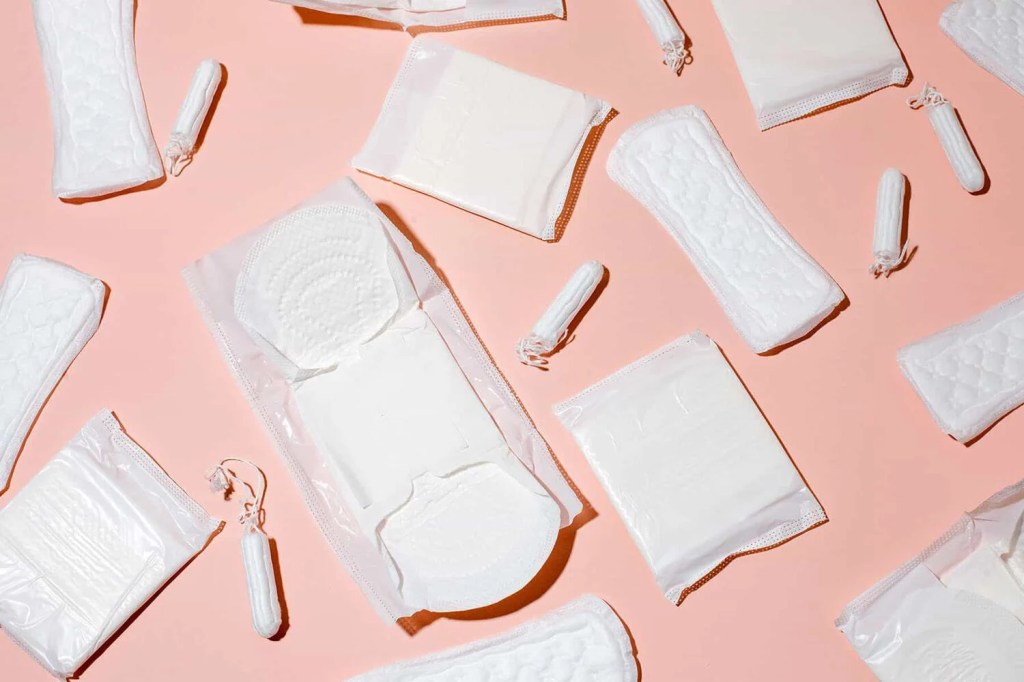
Period products have grown in variations and availability over the last few years, which allows us so many options to choose from depending on our comfortability, preferences, financial accessibility, and so much more.
But with this choice can come confusion as to what period product may be best for you.
To start, let’s break down the options that are available in today’s world:
Periods in Pain recognizes that access to period products can have many barriers. Period products can be expensive, not available in certain areas, and guardians and people in our lives can have control over the options available to us.
Sanitary Pads
Oh, the good old sanitary pad!
Still to this day, the sanitary pad is by far the most widely used period product around the globe. It’s easy to use, typically very accessible, comes in various sizes and flows, and is pain-free.
Did you know that sanitary pads have been mentioned in literature and human history as far back as Ancient Greece? These were made from cotton or sheep’s wool!
Today, sanitary pads vary in size, flow, with wings, without wings, for thongs and full underwear. Pads are a wonderful option for anyone who has a period, regardless of age, flow, job, and lifestyle.
That being said, we are the first to say it took a few years to convince ourselves to return back to the handy-dandy pad. We aren’t sure why or what made us think we should do away with the days of the pad as a teenager and young adult, but alas, we did. Call it peer pressure, the stigmatization of periods and period blood, the lack of education about the menstrual cycle, and pop culture and movies telling our younger selves that pads were “gross”; whatever it was, it got to us. Unless it was an overnight pad, you couldn’t catch us using anything but tampons.
Now, as grown adults, we have re-found our initial love for the pad. It’s easy, hassle free, relatively affordable, pain-free. Ah, pain-free, let’s talk about that for a minute.
The insertion of a tampon should never ever ever cause pain. However, it can. If you suffer from endometriosis, depending on where the endo is in your body, the insertion of a tampon can cause intense pain. For our Founder, who has stage 4 endometriosis, her first and second day of her period very often is ridden with so much pain that even the thought of inserting a tampon makes her nauseous. This is also why she cannot use period discs or cups.
In today’s world, you can even find the emergence of reusable pads! These are washable and another amazing innovation towards more long-term affordability and environmentally friendly options.
Tampon
Tampons are small in size, easy to carry on your person at all times in case of an emergency, fairly accessible, and for the seasoned user, easy to use.
The first tampon was patented in 1933 and called “Tampax”. They were created after concern that the sanitary pads of the day could cause infection.
Now, we all know that tampons, as widely used and loved as they are, do have health concerns. Most notably is toxic shock syndrome. If you use tampons, please change them, regardless of lightness of flow, every 4 to 6 hours. It’s best to not sleep in them either, opting for an overnight pad or period underwear instead.
Tampons, like pads, come in various sizes based on flow. They also have different style applicators (and even applicator free ones!). Tampons often come with a learning curve, so don’t be afraid to experiment with different sizes, styles, and even brands, if you aren’t sure yet which one works best for you. And remember: any pain is a red flag! There should not be any pain or discomfort, so if there is, remove the tampon immediately and insert a new, sanitary one.
There are lots of very helpful videos and diagrams on tampon insertion on the internet. Don’t be afraid to watch the Tampax or Kotex videos to be sure you’re inserting tampons the right way!
As we mentioned above, if you have endometriosis, wearing a tampon during your period may not be accessible to you as it causes increased pain. Listen to your body: if it cannot have a tampon in during any day or days of your cycle due to your endo, please do not wear them.
Menstrual Disc and Cup
A menstrual cup or disc is a type of reusable period product that is small, flexible, and either disc or funnel-shaped cup made of rubber or silicone that you insert into your vagina to catch and collect period fluid.
Cups and discs can hold more blood than other methods, leading many to use them as an eco-friendly alternative to tampons. And depending on your flow, you can wear a cup for up to 12 hours! However, they can still cause toxic shock syndrome, so be sure to follow the instructions carefully.
Like tampons and pads, menstrual cups and discs come in different styles and sizes, with lots of brands to choose from in today’s world. There are also different insertion methods, such as an applicator, the tulip fold, and more.
To figure out the right menstrual cup or disc size for you, we recommend talking to your doctor if you’re comfortable to help evaluate which size may be best for you. Things to consider in size of cup or disc include:
- your age
- length of your cervix
- whether or not you have a heavy flow
- firmness and flexibility of the cup
- cup capacity
- strength of your pelvic floor muscles
- if you’ve given birth vaginally
Smaller menstrual cups and discs are typically recommended for women younger than 30 years old who haven’t delivered a baby vaginally. Larger sizes are often recommended for women who are over 30 years old, have given birth vaginally, or have a heavier period. However, that is generalization, so be sure to do your research to find out which is best.
Period Nirvana is an amazing resource for everything menstrual cups and discs. She has a Youtube and a Tiktok page! Be sure to check her out!
For many, the menstrual cup and disc is a game changer for period products. Not only are the environmentally friendly (though you do need fresh, clean water for their cleaning) they are often considered as more affordable in the long run than tampons or pads as they are reusable.
All that being said, menstrual cups and discs do have a learning curve, and not everyone may feel comfortable using them. The key to all this is using what is right for you. Just like tampons, menstrual cups and discs may increase your endo pain, so be sure to listen to your body.
Period Underwear
Perhaps a new pip favourite, period underwear is becoming more and more popular and accessible. While not yet on the accessibility levels of pads or tampons (and even menstrual cups), period underwear is an amazing environmentally friendly option for anyone with a period, regardless of age.
Until they become more popular, the financial affordability of period underwear may not be in your range right now. We hope that one day very soon they will be just as accessible as every other product.
Like the menstrual cup, you need fresh, clean water to clean your underwear after every use. Unlike all other products, you can wear your underwear for the whole day or night without needing to change! Different brands have different styles and vary for flow. Our favourite at pip is Knix, a Canadian woman-owned company. We especially love their high waisted and dream short options, as they don’t cut into our low belly and increase our endo and period pain.
References: https://femmeinternational.org/the-history-of-the-sanitary-pad/#:~:text=The%20first%20pads%20were%20made,1888%20%E2%80%93%20called%20the%20Southball%20pad | https://helloclue.com/articles/culture/a-short-history-of-modern-menstrual-product | https://www.healthline.com/health/womens-health/menstrual-cup
 periods in pain